
Fan-tailed turkey
Fold a small bird and a broad, shallow-pleated tail, then tuck them together for a flat Thanksgiving decoration. Two different square sizes; no cutting or glue. This version is intended to lie on a place setting or lean against a card, rather than stand by itself.
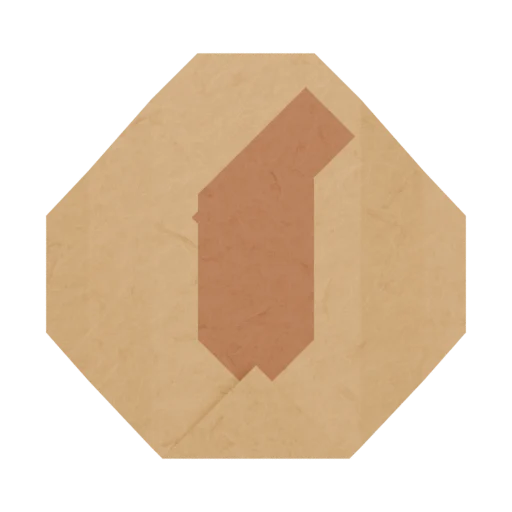
Before you begin
2 sheets · Square paper
20 × 20 cm
No scissors needed
Start foldingThis lesson is being checked for folding accuracy. It has not yet passed a physical fold-through review.
Step-by-step instructions
Read through the fold before you begin, or open any step in the folding viewer.
Printable guide (opens a new tab)
Two squares, two parts
Use a small square for the body and a larger square for the tail. The body square is about two-thirds of the tail square. Set both down as diamonds, with the smaller one on the left.
Look for: Both complete sheets are visible; the body is smaller than the tail.
See this fold
Narrow the left side
On the small diamond, fold its left point inward along the vertical crease shown. Keep the top and bottom points in place.
Look for: The left edge of the body is straight, with its point folded inside.
See this fold
Narrow the right side
Fold the right point inward along the matching vertical crease. Flatten the overlap. The two long points will become the head and belly.
Look for: A narrow vertical body remains, with an upper and lower point.
See this fold
Bend the head sideways
Fold the upper point down and to the right along the sloping crease. Let the small point project from the body as the beak.
Look for: The beak points to the right; the lower body point is still free.
See this fold
Soften the tail outline
On the large diamond, fold the far left and right points behind, then fold the very top point behind. Follow the three highlighted creases in order.
Look for: The tail has a broad top and softened sides, with its lower point untouched.
See this fold
Make a lower pocket
Fold the tail's bottom point upward along the short horizontal crease. Leave this little flap slightly open; its upper edge is the opening for the body.
Look for: A small triangular flap sits in front of the bottom of the tail.
See this fold
Pleat the right tail
Fold the right outer section forward slightly, then fold the narrower outer strip back. Keep the middle of the tail flat. These shallow folds make two ridges rather than a tightly closed accordion.
Look for: The right edge has a visible zigzag in depth; the central pocket stays flat.
See this fold
Pleat the left tail
Repeat the shallow forward-and-back folds on the left. Do not press the tail completely flat; match the open angle on the right.
Look for: Both outer edges are softly pleated around a broad central fan.
See this fold
Bring the body to the tail
Move the bird above the tail, with the beak pointing right. Bring its lower point to the opening of the triangular pocket.
Look for: The body is centered over the tail and its bottom point is just above the pocket.
See this fold
Tuck the lower point
Slide the bird's lower point down behind the triangular pocket flap. Leave the head and upper body visible. Adjust the tuck gently on your real paper so the two sheets stay together.
Look for: The lower body point is hidden by the pocket flap; the beak and pleated fan remain visible. Lay the turkey flat or lean it against a place card.
See this fold